
 EN
EN
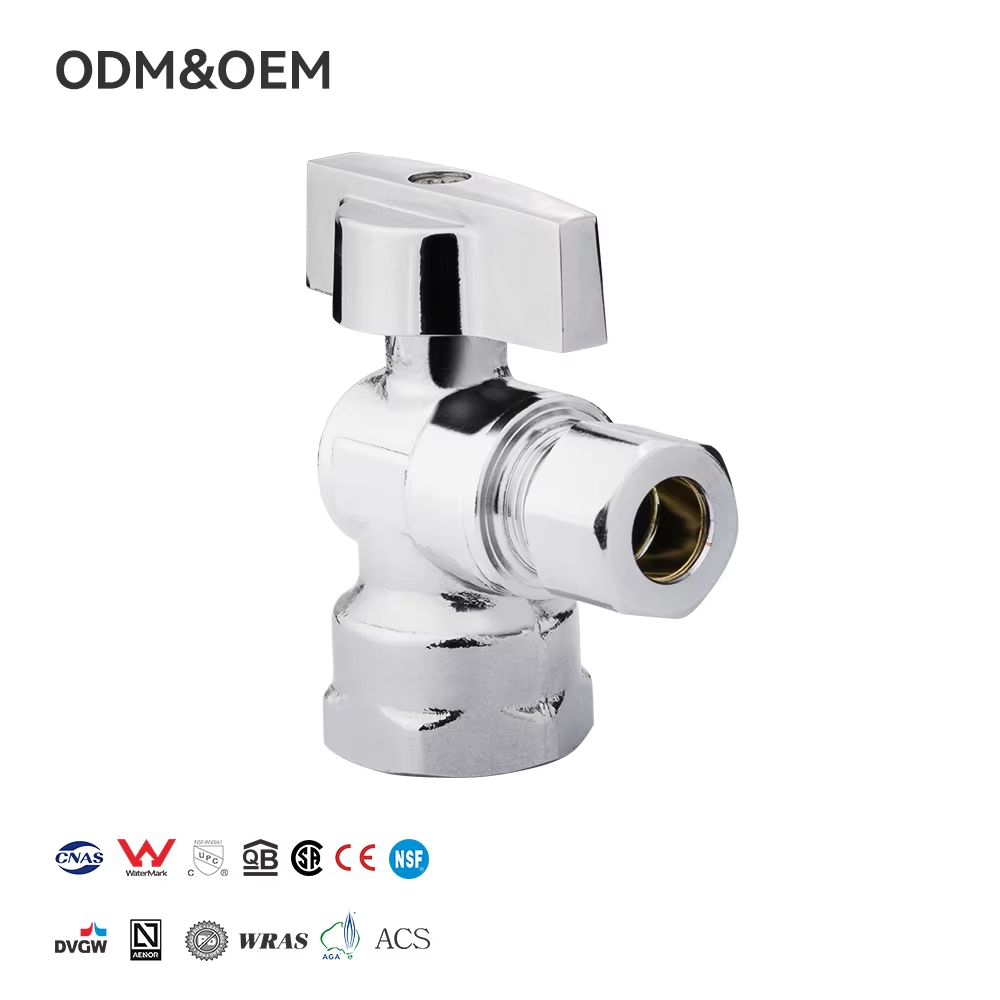
A stop valve stands as one of the most fundamental yet distinctive valve types in industrial and residential applications, designed specifically to provide complete flow shutoff rather than flow regulation. Understanding the key differences between a stop valve and other valve types becomes crucial for engineers, facility managers, and maintenance professionals who need to select the right valve for specific operational requirements. The primary distinction lies in the stop valve's binary operation principle, where it functions in either a fully open or fully closed position, contrasting sharply with other valve types that offer variable flow control capabilities.
The operational mechanism of a stop valve centers around its ability to create a complete seal when closed, effectively stopping all fluid flow through the pipeline system. This fundamental characteristic separates it from throttling valves, control valves, and other valve categories that are engineered to modulate flow rates rather than achieve complete shutoff. The stop valve's design philosophy prioritizes sealing integrity over flow control precision, making it the preferred choice for isolation applications where preventing fluid passage takes precedence over flow adjustment capabilities.
Fundamental Design Principles of Stop Valves
Construction and Sealing Mechanisms
The stop valve construction revolves around a simple yet effective sealing mechanism that differentiates it from other valve types through its focus on tight shutoff capabilities. The valve body houses a movable disc or plug that travels perpendicular to the flow path, creating a seal against a seat when the valve reaches the closed position. This perpendicular motion distinguishes the stop valve from gate valves, where the sealing element moves parallel to the flow direction, and from globe valves, where the closure member follows an angular path to the seat.
The sealing interface in a stop valve typically employs either a resilient seat design using elastomeric materials or a metal-to-metal sealing configuration for high-temperature applications. This sealing approach creates a fundamental difference from ball valves, which achieve shutoff through a rotating spherical element, or butterfly valves, which use a pivoting disc mechanism. The stop valve's linear sealing motion provides consistent sealing force distribution across the entire seat circumference, ensuring reliable shutoff performance even after extended periods of operation.
Operational Characteristics and Performance
The operational profile of a stop valve emphasizes binary functionality, where the valve operates exclusively in fully open or fully closed positions without intermediate throttling capabilities. This operational characteristic creates a clear distinction from control valves, which are specifically designed to operate at various intermediate positions to regulate flow rates. The stop valve's stem mechanism typically incorporates rising or non-rising configurations, both designed to provide positive indication of valve position while maintaining the primary focus on complete flow isolation.
The torque requirements for stop valve operation generally remain moderate compared to gate valves of similar size, primarily due to the perpendicular sealing motion that reduces friction during operation. This operational advantage becomes particularly evident when comparing stop valve performance to wedge gate valves, where high seating forces can create significant operational torque requirements. The stop valve design inherently minimizes the potential for disc binding or stem galling issues commonly associated with parallel-sliding gate valve mechanisms.
Comparative Analysis with Gate Valves
Sealing Mechanism Differences
The fundamental difference between a stop valve and gate valve lies in their respective sealing mechanisms and flow path configurations. A gate valve employs a wedge or parallel gate that slides perpendicular to the flow direction, creating sealing contact along the entire gate perimeter when closed. In contrast, the stop valve utilizes a disc or plug that moves perpendicular to the flow path, creating a point or line contact seal against a circular seat arrangement.
Gate valves excel in applications requiring minimal pressure drop when fully open, as the gate completely withdraws from the flow path, creating an unobstructed passage. The stop valve, however, maintains some flow restriction even when fully open due to the valve body geometry and seat configuration. This difference makes gate valves preferable for mainline isolation applications where flow efficiency takes priority, while stop valves prove more suitable for branch connections and service applications where moderate pressure drop remains acceptable in exchange for superior sealing reliability.
Maintenance and Durability Considerations
The maintenance requirements for stop valves typically prove less demanding compared to gate valves due to their simpler sealing geometry and reduced potential for seat damage. Gate valve seats can experience scoring from debris or particles trapped between the gate and seat surfaces during operation, while stop valve seats benefit from the perpendicular sealing motion that tends to wipe the sealing surfaces clean during closure. This self-cleaning action of the stop valve mechanism contributes to extended service life and reduced maintenance frequency in typical industrial applications.
Stop valve stem packing arrangements generally require less frequent adjustment compared to gate valve packing systems, primarily due to the lower stem forces and reduced stem travel distances involved in stop valve operation. The compact actuator requirements for stop valves also simplify maintenance procedures and reduce the overall system complexity compared to gate valve installations that may require larger actuators to overcome higher operating torques.
Distinction from Ball and Butterfly Valves
Actuator and Control Interface Differences
The actuator interface requirements for stop valves differ significantly from ball and butterfly valve configurations due to their linear motion operating mechanism. Stop valves require linear actuators or multi-turn rotary actuators with stem nut arrangements to convert rotational motion into linear displacement. This contrasts sharply with ball valves and butterfly valves, which utilize quarter-turn rotary actuators that provide rapid operation through 90-degree rotation cycles.
The control signal interface for automated stop valve applications typically involves longer stroke times compared to ball or butterfly valve installations. While a stop valve may require 15-30 seconds for full stroke operation, ball and butterfly valves can complete their full range of motion in 3-5 seconds. This timing difference influences system design considerations for emergency shutdown applications where rapid valve closure becomes critical for process safety.
Flow Coefficient and Pressure Drop Characteristics
The flow coefficient characteristics of stop valves generally fall between those of gate valves and globe valves, offering moderate flow capacity with acceptable pressure drop values for most isolation applications. Ball valves typically provide the highest flow coefficients among shutoff valve types due to their full-bore design capabilities, while butterfly valves offer excellent flow capacity relative to their compact installation envelope. Stop valves balance these performance aspects by providing reliable sealing with moderate flow restrictions.
The pressure recovery characteristics downstream of stop valves differ from ball and butterfly valves due to their internal flow path geometry. Stop valves create a more gradual pressure recovery profile compared to the sharp pressure recovery associated with ball valves, while providing better pressure recovery than the typical globe valve configuration. This flow characteristic influences system hydraulic calculations and pump sizing considerations in applications where the stop valve operates in partially open positions during startup or shutdown sequences.
Application-Specific Selection Criteria
Service Conditions and Environmental Factors
The selection between stop valves and other valve types often depends on specific service conditions that favor the stop valve's operational characteristics. High-temperature applications frequently favor stop valves over ball valves due to their ability to accommodate thermal expansion without compromising sealing integrity. The linear sealing mechanism of stop valves provides consistent performance across wide temperature ranges, while ball valve seat materials may experience thermal degradation or loss of sealing effectiveness under extreme temperature conditions.
Corrosive service applications benefit from stop valve designs that allow for replaceable seat components and simplified internal access for maintenance procedures. Unlike butterfly valves, where the entire valve may require removal for seat replacement, stop valves typically permit in-line maintenance of sealing components. This maintenance advantage proves particularly valuable in chemical processing applications where frequent exposure to aggressive media necessitates regular seal replacement procedures.
Installation and Space Considerations
The installation envelope requirements for stop valves differ from other valve types due to their stem extension and actuator mounting arrangements. Stop valves require vertical clearance above the valve body to accommodate stem travel and actuator installation, similar to gate valves but contrasting with the compact installation profile of butterfly valves. However, stop valves generally require less installation space than globe valves due to their straight-through body configuration rather than the angular flow path of typical globe valve designs.
Piping stress considerations favor stop valves in applications where thermal expansion creates significant pipeline movement, as their robust body construction and secure bonnet attachment provide superior resistance to external loading compared to butterfly valve wafer-style installations. The flanged or threaded end connections of stop valves create more positive pipe joint integrity compared to wafer-style butterfly valves that rely on pipeline flange compression for body retention.
Performance Characteristics in Industrial Applications
Pressure Rating and Temperature Capabilities
The pressure rating capabilities of stop valves typically exceed those of comparable butterfly valves due to their robust body construction and secure closure mechanism. Stop valve pressure ratings commonly extend to ANSI Class 2500 and beyond, while standard butterfly valves generally limit to Class 600 ratings without significant design modifications. This pressure capability advantage makes stop valves the preferred choice for high-pressure steam service, hydraulic systems, and other applications where system pressures exceed the practical limits of alternative valve types.
Temperature performance characteristics of stop valves benefit from their ability to accommodate both metallic and soft seat configurations depending on service requirements. High-temperature steam applications favor metal-seated stop valve designs that maintain sealing integrity at temperatures exceeding 800°F, while soft-seated versions provide superior shutoff tightness for moderate temperature liquid services. This temperature versatility distinguishes stop valves from ball valves, which may experience seat distortion or leakage at elevated temperatures due to thermal expansion mismatch between ball and seat materials.
Leakage Performance and Sealing Standards
The leakage performance standards for stop valves align with industrial requirements for positive shutoff applications, typically achieving API 598 or similar tightness classifications. Stop valve sealing performance generally surpasses that of gate valves in long-term service due to their perpendicular sealing mechanism that minimizes the potential for seat scoring or damage from pipeline debris. While ball valves may provide initially superior sealing performance, stop valves maintain consistent sealing effectiveness over extended service periods without the potential for seat degradation associated with ball valve thermal cycling.
The fugitive emission performance of stop valve stem sealing systems typically meets or exceeds EPA requirements for industrial valve applications through proven packing arrangements and stem surface treatments. Stop valve packing systems benefit from lower stem operating forces compared to gate valves, reducing the potential for packing extrusion or relaxation that can lead to fugitive emissions. This emission control advantage becomes particularly important in environmental compliance applications where stop valves serve as primary isolation devices.
FAQ
What is the main difference between a stop valve and a control valve?
The main difference lies in their intended function and operational characteristics. A stop valve operates in only two positions - fully open or fully closed - and is designed primarily for isolation service to completely stop flow when needed. Control valves, in contrast, are engineered to operate at various intermediate positions to regulate and modulate flow rates, featuring precise positioning capabilities and often incorporating feedback control systems for automated flow adjustment.
Can a stop valve be used for throttling applications?
While technically possible, stop valves should not be used for regular throttling service. Stop valve internal designs optimize for tight shutoff rather than flow control, and operating them in partially open positions can cause seat damage, erosion, and premature wear. For throttling applications, globe valves, control valves, or needle valves provide better performance and longer service life due to their flow-modulating design characteristics.
How does the installation cost of stop valves compare to other valve types?
Stop valve installation costs typically fall in the middle range compared to other valve types. They generally cost less to install than gate valves due to lower actuator torque requirements and simpler mounting arrangements, but more than butterfly valves due to their larger installation envelope and heavier weight. The total cost of ownership often favors stop valves in isolation applications due to their lower maintenance requirements and longer service life compared to more complex valve types.
What maintenance intervals are recommended for stop valves in typical industrial service?
Maintenance intervals for stop valves typically range from 2-5 years depending on service conditions, with annual inspection recommended for critical applications. The straightforward design of stop valves generally requires less frequent maintenance compared to gate valves or control valves. Routine maintenance includes packing adjustment, stem lubrication, and seat inspection, with major overhauls involving seat replacement or internal component renewal typically scheduled every 5-10 years in standard industrial service conditions.